Home Hardware
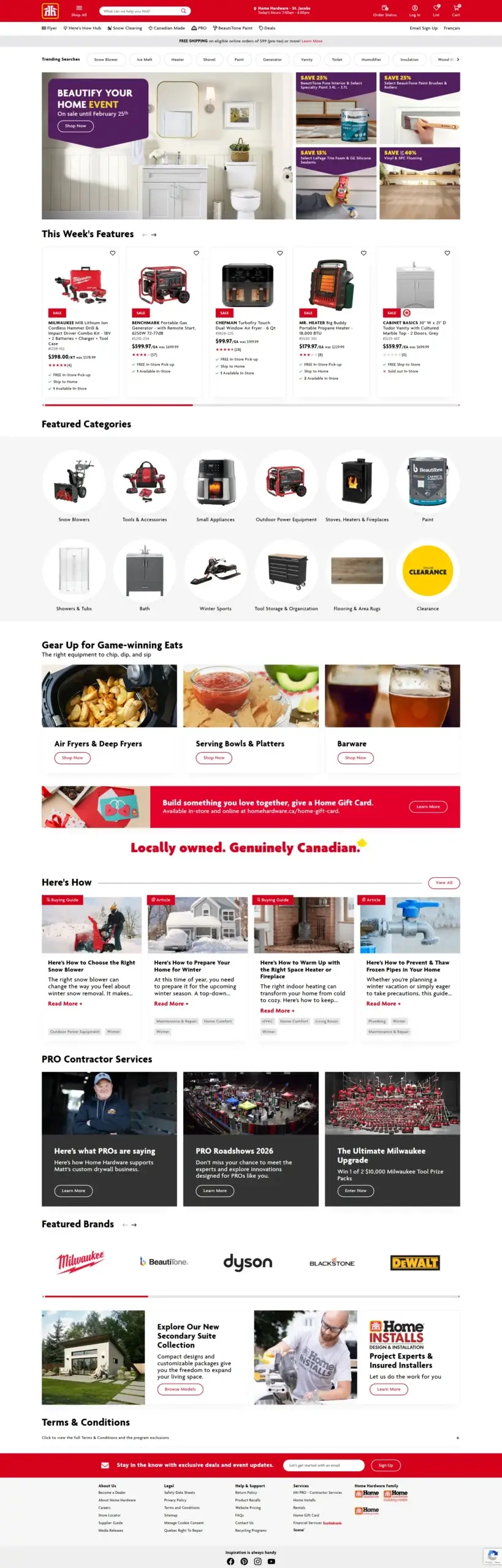
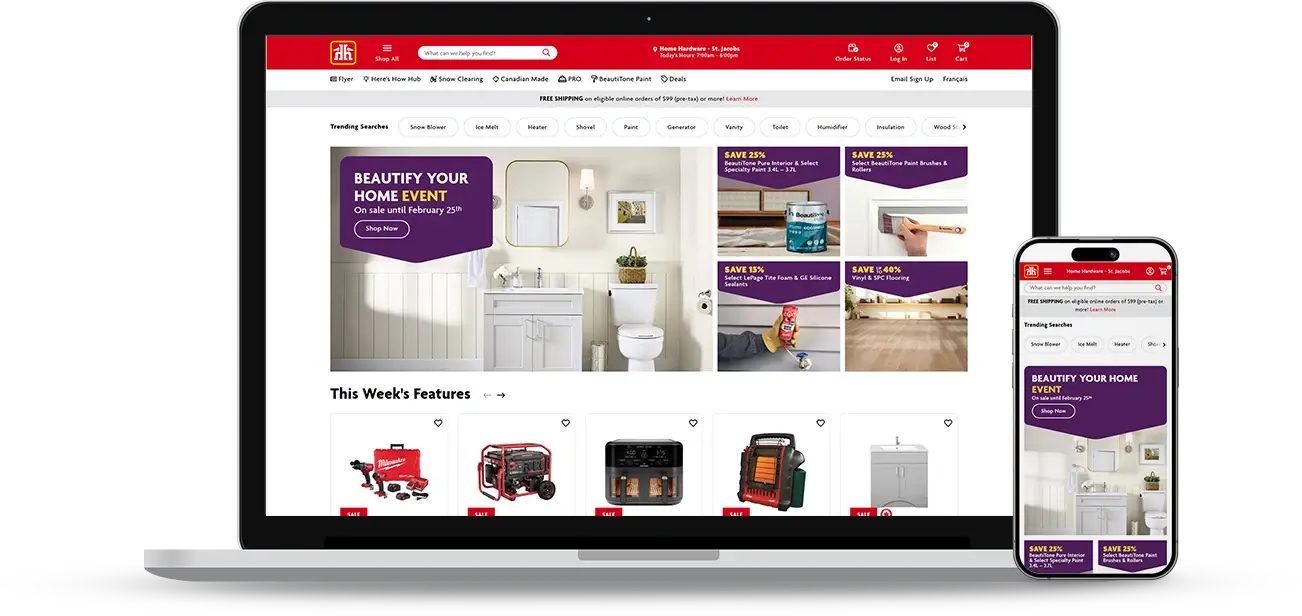
Empowered homeowners & contractors through a website that’s holistic and customer-centric.
- Implemented a Headless Commerce architecture to reduce the website load time significantly.
- Designed a geolocation-specific store that automatically pairs users with their nearest dealer.
- Incorporated seamless third-party API integrations for seamless checkout options.

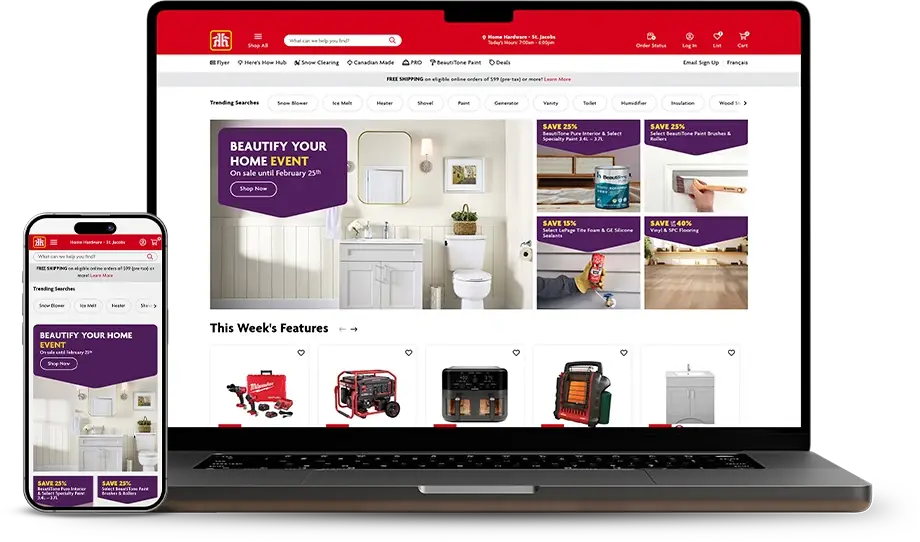


Project
Home Hardware
Niche
Home Improvement
Industry
Home Improvement Retail
Technology
Python, JavaScript, AWS Cloud Hosting
About Home Hardware
Home Hardware is Canada’s largest independent home improvement retailer. It was established in 1964 in St. Jacobs, Ontario and is known for its quality tools and robust building materials.
Their main goal is to improve people’s lives at home by empowering homeowners and contractors with reliable products. They also provide professional advice and impeccable convenience so that individuals can take care of any project with confidence. Since the stores are independently owned by community members, there’s a lot of focus on providing the right local service and homegrown quality in their products. With more than 60 years of proud history, Home Hardware remains at the core of Canadian home improvement.
Services
Major Challenges Faced By the Home Hardware

Lack of Mobile-First Architecture
Their website was built at a time when desktop computers dominated instead of smartphones. They tried to implement the responsive patches, but the foundational code was still very heavy because of the legacy scripts. That’s why their website was suffering from slow “Time to Interactive”(TTI) and “Cumulative Layout Shift”(CLS) issues. The site buttons were placed too close and the search bar was non-functional on smaller screens. Their site’s poor mobile performance was hampering their business significantly.
Confusing User Experience
Home Hardware has a unique business model, and its website wasn’t providing its target audience with the precise information about what it does. The user experience(UX) was also disjointed, and the buyer journey didn’t have any end in sight, which forced the customers to call the store. This friction was hampering their conversions, and they were not getting many orders for their products. So, their confusing UX was slowing down their business growth.
Scalability & Checkout Issues
Their websites used to choke during big sales events and seasonal peaks as well. In fact, the website’s back-end was made on older and on-premise server logic, which couldn’t handle the big spikes in regular users. Moreover, the checkout process had many steps, which were causing high abandonment rates. It didn’t have the contemporary integrations and modern security measures, along with the relevant payment protocols as well.
How Did We Provide Solutions For These Challenges?
Headless Commerce Architecture
Geolocation-Driven Logic
Unified PIM System
Migration to Cloud Infrastructure
AI-Powered Discovery
Our first step to solve a bloated and slow user interface was to move their website to a Headless Commerce architecture. For this setup, the frontend of the site was decoupled from the backend logic, inventory, and database. So, our frontend developers were able to use cutting-edge frameworks like React to craft a quick-loading, app-like experience on the web. That’s why it wasn’t being slowed down because of the heavy legacy backend. It was pretty important for Home Hardware as they have several products to showcase to their target audience. This allowed the website to load the content in a dynamic manner instead of reloading the whole page. Due to this, issues such as “Technical Debt” and “Mobile-First” were solved. This allowed for an optimized and responsive interface which functions smoothly on every device.
Delivered Results
Home Hardware Success:
- Increased average time-on-page by 52% once every webpage was redesigned.
- The bounce rate of the homepage was reduced by 28%.
- There was an increase of 31% in add-to-cart clicks.
- Each product page had 100% enriched content now.
- Cart abandonment rate dropped by 22%.
- Buy online, pick up in-store revenue increased by 38%.
Conversion & Retention:
- Click-through rate of the product pages increased by 46%.
- Email opt-ins grew exponentially by 64%.