


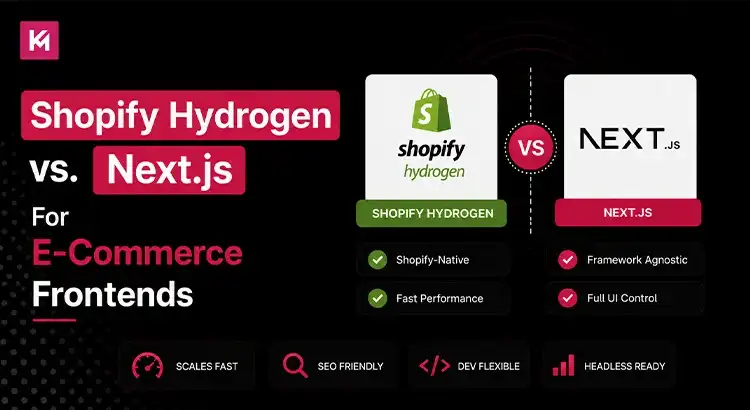
Shopify Hydrogen vs. Next.js For E-Commerce Frontends
Choosing the right frontend for your e-commerce store can directly impact website speed, customer experience, and long-term scalability. This matters because even small performance issues can affect conversions. Google research has shown that as page load time increases from 1 to 3 seconds, the probability of a mobile user leaving a website can increase significantly.
But with modern options like Shopify Hydrogen and Next.js, many businesses struggle to understand which technology actually fits their goals.
Shopify Hydrogen is designed for brands that want a custom storefront while staying connected to Shopify’s ecosystem. Next.js offers more flexibility for businesses that need complete control over their frontend experience and want to build beyond a traditional online store.
If your business is Shopify-focused and you want a faster, more flexible storefront, Hydrogen may be the right fit. If you are building a more complex digital experience with custom features, multiple integrations, or a broader technology ecosystem, Next.js may provide the flexibility you need.
The right choice is not about choosing the more advanced framework. It is about choosing the technology that supports your e-commerce goals today and gives your business room to grow tomorrow.
Shopify Hydrogen vs Next.js: Quick Comparison
Here’s the high-level breakdown before we get into the weeds.
| Factor | Shopify Hydrogen | Next.js |
|---|---|---|
| Technology type | Shopify’s React-based storefront framework | React-based full-stack web framework |
| Best suited for | Shopify-focused e-commerce brands | Businesses needing flexible e-commerce experiences |
| Flexibility | High, but within Shopify’s ecosystem | Very high, with broader architecture options |
| Performance | Optimized for Shopify storefronts | Depends on implementation |
| Development complexity | Lower for Shopify stores | Higher due to greater flexibility |
| Customization level | Strong e-commerce customization | Almost unlimited frontend customization |
| Shopify integration | Native | Requires APIs and custom builds |
| Scalability | Excellent for Shopify-based growth | Excellent for complex digital ecosystems |
| Maintenance | More streamlined | Requires more technical planning |
| Ideal use case | Shopify Plus brands wanting modern storefronts | Brands building unique commerce experiences |
Both frameworks support headless commerce. They just go about it differently, and that difference matters more than most brands realize until they’re six months into a build.
What Is Shopify Hydrogen?
Shopify Hydrogen is Shopify’s React-based framework designed specifically for building custom e-commerce storefronts. Traditional Shopify stores usually depend on themes that control the frontend experience. Hydrogen changes that approach by allowing developers to build a completely custom storefront while Shopify continues managing e-commerce operations behind the scenes. This means Shopify handles:
- Products
- Inventory
- Checkout
- Payments
- Customer accounts
- Orders
While Hydrogen manages the customer-facing experience.
Technically, Hydrogen connects with Shopify through the Storefront API and uses modern React development practices, including server-side rendering and optimized data fetching. For Shopify Plus brands, this creates an opportunity to move beyond theme limitations while keeping Shopify’s trusted commerce infrastructure.
According to Shopify, more than 5 million businesses worldwide use Shopify, making it one of the most widely adopted e-commerce platforms globally. For many of these brands, Hydrogen provides a way to improve their storefront experience without changing their entire commerce system.
How Shopify Hydrogen Works
A traditional Shopify theme combines frontend and backend functionality inside Shopify. Hydrogen separates them. The architecture looks like this:
Customer → Hydrogen storefront → Shopify Storefront API → Shopify backend
This allows brands to create:
- Custom product pages
- Unique navigation experiences
- Interactive shopping journeys
- Personalized storefronts
- Advanced animations and interactions
For example, a premium fashion retailer may want a visually rich shopping experience with interactive product discovery, editorial content, and personalized recommendations.
A traditional theme may feel restrictive, but Hydrogen gives developers more room to create that experience.
Advantages of Shopify Hydrogen
Shopify Hydrogen works well for brands that want customization without moving away from Shopify. Key benefits include:
- Native Shopify integration
- Faster e-commerce development
- Modern storefront capabilities
- Better control over customer experience
Limitations of Shopify Hydrogen
Despite its flexibility, Hydrogen is still closely connected to Shopify. Some limitations include the following:
- Less freedom outside the Shopify ecosystem
- More dependency on Shopify APIs
- Not ideal for businesses combining multiple commerce platforms
- Requires React development expertise
If your business plans to build a larger digital ecosystem involving multiple platforms, Next.js may offer more flexibility.
What Is Next.js?
Next.js is a React framework built for fast, scalable, highly customizable websites and applications. Unlike Hydrogen, it wasn’t designed specifically for e-commerce. Developers use it for everything from content platforms to enterprise dashboards to fully custom storefronts.
For e-commerce brands, Next.js usually shows up as the frontend layer in a headless setup, paired with a commerce backend like Shopify, BigCommerce, Magento, or a custom API. That separation hands businesses far more control over how the frontend is structured. The backend could be Shopify, Magento, BigCommerce, custom APIs, or another system. This separation gives businesses complete control over their frontend.
How Next.js Works for E-Commerce
With Next.js, developers build the entire customer experience independently. This allows brands to create the following:
- Custom shopping experiences
- Advanced personalization
- Complex product configurators
- Multi-region websites
- Unique customer journeys
For example, a global retailer may need e-commerce, content marketing, customer dashboards, loyalty systems, and multiple integrations. Next.js can support this kind of architecture because it is not tied to a single commerce platform.
Advantages of Next.js
The biggest advantage of Next.js is flexibility. Businesses choose it because it offers:
- Complete frontend control
- Support for complex integrations
- Freedom to connect multiple systems
- Greater long-term architectural flexibility
Next.js is especially valuable for companies where e-commerce is only one part of a larger digital experience.
Limitations of Next.js
More freedom also means more responsibility. Businesses need to manage the following:
- Hosting decisions
- API integrations
- Performance optimization
- Frontend maintenance
- Development resources
A poorly planned Next.js e-commerce project can become expensive and difficult to maintain.
Key Differences Explained
Flexibility and Customization
Hydrogen keeps Shopify at the centre while still letting you customize layouts, animations, and shopping flows well beyond what a theme allows. Next.js goes further, letting developers connect multiple data sources and build applications that go far past a typical online store.
| Requirement | Better Fit |
|---|---|
| Custom Shopify storefront | Shopify Hydrogen |
| Unique customer experience | Next.js |
| Multi-platform architecture | Next.js |
| Shopify-native features | Shopify Hydrogen |
| Complex custom applications | Next.js |
A Shopify Plus brand focused on selling products tends to do well with Hydrogen. A company building a full digital ecosystem usually leans toward Next.js.
Performance and Speed
Both frameworks can deliver fast storefronts, but speed comes down to how well the build is executed. Hydrogen ships with e-commerce-focused optimization already baked in, since it’s tied directly to Shopify’s infrastructure. Next.js relies on server-side rendering and static generation, which can be just as fast, but only if your team makes smart architectural calls along the way.
Here’s the honest part nobody likes to admit: a poorly built Next.js storefront will absolutely underperform a well-built Hydrogen store. Speed isn’t just about the framework you pick. Code quality, hosting choices, content delivery, and integration planning all play a part.
Development Complexity
This is where a lot of businesses underestimate what they’re signing up for. Hydrogen reduces complexity for Shopify stores because Shopify already handles product data, checkout, inventory, and core commerce logic. Next.js gives developers more control, which comes with more decisions to make upfront, such as:
- How product data gets managed and synced
- How APIs connect the frontend to the backend
- How content gets delivered across the site
- How different systems talk to each other
- How the whole thing gets hosted and maintained
Teams with strong technical resources often see this flexibility as a genuine advantage. Teams that want something simpler to maintain long-term usually lean towards Shopify Hydrogen instead.
Shopify Integration
Shopify Hydrogen has native access to Shopify’s Storefront API since it was built specifically for that ecosystem. Next.js can absolutely connect to Shopify too, just through custom API work rather than a built-in relationship. That means more flexibility, but also more development time spent on integration work.
The real question for your business: Is Shopify just your current platform, or is it the actual foundation of your long-term digital strategy? That answer should guide the decision more than anything else on this list.
Real-World Scenarios: Which One Actually Makes Sense?
Scenario 1: Shopify Plus Brand Wants a Better Storefront
A growing Shopify Plus company wants:
- Better performance
- More customization
- Improved customer experience
But it does not want to rebuild its e-commerce operations. Shopify Hydrogen is likely the better option. The brand keeps Shopify’s backend while improving the frontend experience.
Scenario 2: Brand Needs a Fully Custom Digital Experience
A business needs:
- Product personalization
- Customer dashboards
- Complex integrations
- Custom buying journeys
Next.js may be the better choice because the frontend is not restricted by Shopify’s structure.
Scenario 3: e-commerce Is Part of a Larger Ecosystem
Some companies operate across the following:
- e-commerce
- Mobile apps
- Content platforms
- Customer portals
- Multiple business systems
For these businesses, Next.js often provides more architectural freedom.
Shopify Hydrogen vs Next.js: Pros and Cons
| Technology | Advantages | Limitations |
|---|---|---|
| Shopify Hydrogen | Shopify-focused, easier integration, modern storefront development | More Shopify dependency, less freedom |
| Next.js | Maximum flexibility, complex architecture support, flexibility | Requires more technical expertise, more maintenance responsibility |
Shopify Hydrogen Advantages
- Shopify-focused development: Hydrogen is built around Shopify, making it a natural choice for Shopify Plus brands.
- Faster e-commerce implementation: Businesses can focus on improving customer experience instead of rebuilding e-commerce functionality.
- Modern storefront experience: Brands can move beyond standard Shopify themes and create unique shopping journeys.
Shopify Hydrogen Limitations
- Shopify dependency: Businesses moving away from Shopify may need additional development work.
- Less freedom compared to Next.js: Hydrogen is flexible, but it still operates within Shopify’s ecosystem.
Next.js Advantages
- Complete customization: Brands can build unique experiences without being restricted by platform structure.
- Supports complex business requirements: Next.js works well for businesses combining e-commerce with other digital services.
- Long-term flexibility: It provides a strong foundation for businesses building advanced digital ecosystems.
Next.js Limitations
- Higher technical requirements: Businesses need experienced developers to manage the architecture.
- More maintenance responsibility: Teams must handle more parts of the technology stack.
Which One Should You Choose?
There is no universal winner between Shopify Hydrogen and Next.js. Both technologies solve different e-commerce challenges, and the right choice depends on your business model, technical requirements, and future growth plans.
A small Shopify brand looking for a faster, more flexible storefront may have very different needs compared to a global e-commerce company building a complex digital ecosystem. Instead of choosing based on which technology sounds more advanced, businesses should focus on which option supports their long-term goals.
Choose Shopify Hydrogen If You Want a Custom Shopify Experience
Shopify Hydrogen is the better choice for businesses that are already deeply invested in the Shopify ecosystem and want more control over their storefront experience. Traditional Shopify themes can sometimes limit advanced customization. Hydrogen removes many of those restrictions by allowing developers to build custom React-based storefronts while still using Shopify for essential e-commerce operations like product management, checkout, payments, and inventory. This makes Hydrogen especially useful for Shopify Plus brands that want a premium shopping experience without moving away from Shopify’s infrastructure.
Your Business Already Runs on Shopify
If Shopify is already powering your e-commerce operations, Hydrogen allows you to improve your frontend without changing your entire backend system. Instead of rebuilding core commerce features, your team can focus on improving:
- Customer experience
- Website performance
- Storefront design
- Personalization opportunities
This reduces unnecessary complexity while still giving your brand a modern e-commerce experience.
You Want Faster Development and Easier Maintenance
Hydrogen works well for businesses that want customization but do not want to manage every part of a complex e-commerce architecture.
Since Shopify handles many backend responsibilities, development teams can spend more time creating better customer experiences rather than building commerce functionality from scratch.
You Are Building a Shopify Plus Storefront
For Shopify Plus brands, Hydrogen provides the flexibility needed to create unique shopping experiences while keeping Shopify’s enterprise-level commerce features.
It is a strong option for businesses that want a customized storefront but still want Shopify to remain the foundation of their e-commerce strategy.
Choose Next.js If You Need Complete Frontend Freedom
Next.js is the better option for businesses that need more control over how their e-commerce experience is built. Unlike Shopify Hydrogen, Next.js is not limited to one commerce platform. It allows developers to connect different systems, APIs, and technologies to create a completely customized digital experience. This makes it suitable for businesses that see e-commerce as part of a larger digital ecosystem rather than just an online store.
You Need Advanced Customization
If your business requires unique features that go beyond a standard e-commerce experience, Next.js provides more flexibility. Examples include:
- Advanced product configurators
- Custom customer dashboards
- Personalized shopping journeys
- Complex content and commerce integrations
With Next.js, businesses can build experiences that are not restricted by a specific e-commerce platform.
Your Business Uses Multiple Systems
Large businesses often need their e-commerce website to connect with multiple technologies, including:
- Customer relationship management platforms
- Content management systems
- Custom databases
- Third-party applications
Next.js makes these integrations easier to manage because the frontend can be built independently from the backend systems.
You Are Building Beyond a Traditional Online Store
If your long-term plan includes mobile applications, content platforms, marketplaces, or multiple digital experiences, Next.js provides the flexibility to support that growth.
However, this flexibility also requires more technical expertise. Businesses need strong development resources to manage performance, integrations, hosting, and ongoing improvements.
Making the Final Decision
For most Shopify-focused businesses, Shopify Hydrogen is the practical choice because it provides customization without adding unnecessary complexity. For businesses with ambitious digital plans, Next.js offers the freedom to build more advanced and connected experiences.
Before making a decision, consider where your e-commerce business will be in the next three to five years. The right technology should not only solve your current challenges but also support future growth without limiting your options.
Why Businesses Choose Kinex Media for E-Commerce Development
Choosing between Shopify Hydrogen and Next.js requires more than comparing features. The right decision depends on your business model, customer journey, technical goals, and long-term growth plans.
Kinex Media helps businesses build scalable e-commerce experiences by understanding both the technology and the business impact behind every development decision. As a Shopify Plus Partner agency operating out of Toronto and Mississauga since 2008, Kinex Media has spent 18+ years building e-commerce frontends for over 3,000 brands across Canada and the United States, backed by a team of 250+ technical experts who work in both Hydrogen and Next.js environments daily.
From Shopify development and custom e-commerce solutions to advanced frontend experiences, Kinex Media focuses on creating digital platforms that are built for performance, usability, and growth.
If you’re still weighing Shopify Hydrogen against Next.js for your storefront, Kinex Media can walk through your specific growth goals, technical requirements, and customer expectations before you make a decision. Book a free strategy call and find out which path actually fits your business.
Frequently Asked Questions
Is Shopify Hydrogen better than Next.js for e-commerce?
Shopify Hydrogen is better for brands that already rely heavily on Shopify and want a customized storefront without leaving the Shopify ecosystem. Next.js is better for businesses that need complete frontend freedom and complex digital experiences.
Can Shopify Hydrogen and Next.js be used together?
Yes. Both technologies are based on React principles, but they usually serve different roles. Some businesses may use Shopify as the commerce backend while using Next.js for custom frontend experiences.
Is Next.js faster than Shopify Hydrogen?
Not always. Both can deliver excellent performance. Speed depends on architecture, hosting, code quality, caching, and optimization practices.
Is Shopify Hydrogen good for Shopify Plus stores?
Yes. Shopify Hydrogen is especially useful for Shopify Plus brands that want more control over their storefront design, user experience, and performance.
Which is easier to maintain: Shopify Hydrogen or Next.js?
Shopify Hydrogen is generally easier to maintain for Shopify-focused businesses because many e-commerce functions are already handled by Shopify. Next.js provides more flexibility but requires more technical management.
Does Kinex Media help businesses choose between Shopify Hydrogen and Next.js?
Yes. Kinex Media evaluates your e-commerce goals, technical requirements, and future plans to recommend an architecture that supports long-term growth.

